7000 Houston Rd STE 35, Florence, KY 41042

Here’s something that most people don’t know: a routine dental checkup only reveals what’s visible above the surface. What’s going on underneath the bone, between the teeth, and below the gumline needs imaging. When living in Northern Kentucky, knowing what dental radiographs are and how they work can be the difference between recognizing a small issue early and facing a costly one later.
What Dental Radiographs Actually Do
Dental radiographs, or X-rays, are a crucial part of modern dentistry, but they are not just for routine checkups. They are a diagnostic tool — one that allows your dentist to see what a visual exam just can’t. Here’s what they commonly detect:
- Decay between teeth or under existing fillings
- Bone loss due to gum disease
- Infections or abscesses before pain develops
- Cysts or tumors — benign ones and otherwise
- Issues with roots and bad teeth alignment
- Developmental problems in children’s growing teeth
The American Dental Association (ADA) encourages the use of dental radiographs in conjunction with a comprehensive oral health evaluation, not as routine snapshots, but as clinical tools to meet the individual needs of patients.
Digital Radiography: What’s Changed
The days of traditional film X-rays are mostly over. The majority of modern dental offices now use dental radiographs in Florence, which capture images with an electronic sensor rather than film. The difference matters for several reasons:
- Images appear instantly on a screen
- They can be enlarged and enhanced for better clarity
- Radiation exposure is reduced by 80 to 90% compared to traditional X-rays
- Dentists can take precise measurements of cavities, bone levels, and restorations
Now, when it comes to dental radiographs in Florence, for patients in Northern Kentucky, the same digital technology is used — providing a faster, clearer picture with minimal exposure.
To put radiation levels in perspective: the exposure from a regular dental X-ray is less than the background radiation you get from ordinary tasks, like being outside in sunlight or living in a brick house. Both the ADA and the CDC consider it to be at very low risk, and appropriate protective measures are in place.
When Are X-Rays Recommended?
Not every patient needs X-rays at every visit. How often should you go to the dentist? It’s up for debate, but your dentist will decide based on:
- Your age and dental history
- Low risk for decay or gum disease
- Whether you’re a new patient (a full set helps establish a baseline)
- Presence of symptoms such as pain, swelling, or sensitivity
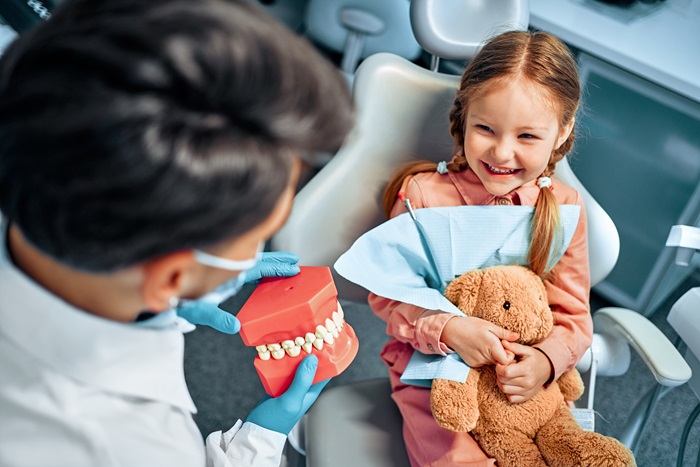
Children may need more frequent monitoring due to developing teeth and a higher risk of cavities. Adults with no recent concerns may only need periodic X-rays every one to two years.
CBCT: 3D Imaging for Complex Cases
CBCT provides 3D images of the teeth, jaws, nerves, and other structures when standard (2D) x-rays cannot give us the information we need. Examples of cases where our patients benefit from having the 3D view that CBCT can provide include:
- Planning a dental implant: We can assess bone density, nerve location, and proximity to the sinus before placement.
- Endodontic examinations: We can accurately determine how many canals there are in the roots of a particular tooth.
- Detecting infection: We can see a tooth abscess or bone loss that may not be apparent on a 2D image.
While not every patient receives a CBCT scan, the increased diagnostic accuracy and improved treatment outcomes usually make a significant difference in the successful outcome of complex cases.
The Benefits of Early Detection
Dental problems caught early in development are usually easier to treat and less expensive.
For example, if you have a cavity discovered on an X-ray that could be treated with a filling, but it is not caught early enough and has now reached the pulp of the tooth, you may require a root canal.
If you have caught early bone loss on imaging, it can be managed and treated effectively with proper gum care. However, if advanced bone loss occurs and is detected late, it may be impossible to reverse the process.
If you have your dental problems diagnosed early through imaging, you will continue to save time, money, and discomfort.
Your Oral Health Deserves a Second Look
If you have been delaying a checkup or avoiding X-rays when “nothing hurts,” that’s exactly when dental radiographs in Florence, is most needed. Pain is generally a late indicator — by the time you feel it, the issue has had an opportunity to evolve.
This is especially worth keeping in mind for families in the Florence and Greater Cincinnati area, where access to modern dental care is close by. Staying proactive with regular imaging is one of the simplest ways you can support long-term oral health.
At Pearl Dental Care, our team employs digital X-rays and advanced imaging technology to provide patients with a complete, accurate picture of their oral health and to detect what a visual exam alone could miss.
Ready to Schedule?
If you are waiting for a dental checkup or have concerns regarding imaging, Pearl Dental Care in Florence, KY, would be happy to help. Contact our dental office or schedule your appointment now!
Common Questions People Have
1. How often should I get dental X-rays?
It depends on your age, dental history, and risk factors. Most adults with no active concerns need X-rays every one to two years. Your dentist will recommend a schedule based on your specific needs.
2. Are dental X-rays safe during pregnancy?
The ADA advises caution during pregnancy. If X-rays are necessary, lead shielding is used. Always inform your dentist if you are pregnant or might be.
3. Can children get dental X-rays?
Yes. Children often need more frequent monitoring due to developing teeth and a higher risk of dental decay. Digital X-rays keep radiation exposure minimal.
4. What is the difference between a bitewing and a panoramic X-ray?
Bitewing X-rays show the upper and lower back teeth in detail, primarily for detecting cavities. Panoramic X-rays capture a full view of the mouth in one image, useful for evaluating jaw structure, bone levels, and tooth development.